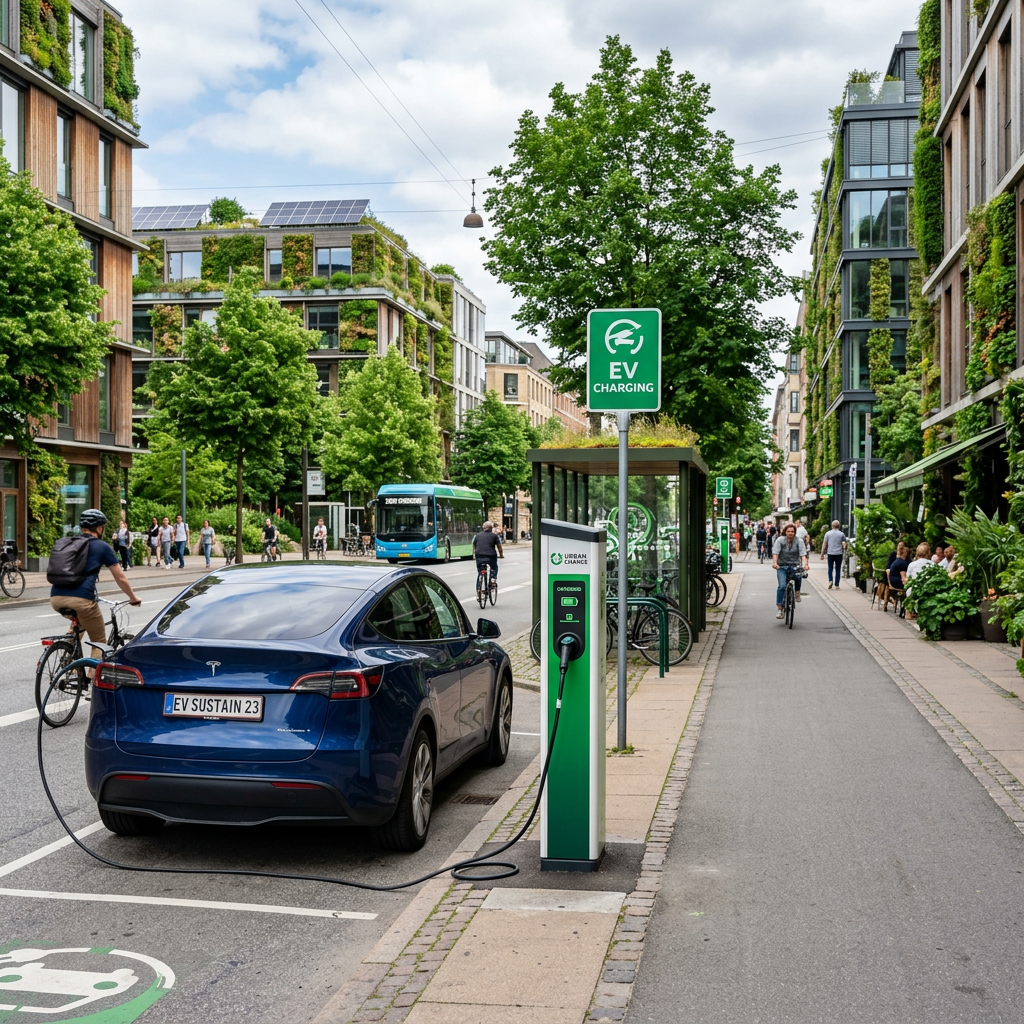
Electric vehicles (EVs) are transforming the automotive industry much quicker than anticipated. Initially created as an alternative to conventional petrol and diesel vehicles, Electric Vehicles have now turned into one of the spheres where breakthroughs are taking place in terms of batteries, charging, artificial intelligence, software development, and automated driving.
In 2026, the Electric Vehicles market is set to go beyond the replacement of the internal combustion engine and develop into more intelligent, fast charging and grid-interactive vehicles. According to the International Energy Agency (IEA), the installation of EV batteries amounted to almost 1.2 TWh in 2025, showing a rise by almost 30% compared to the previous year.
The topic of this article is The Future of Electric Vehicles: Latest Technology Trends and includes the exploration of such trends in electric vehicles as battery technology, charging technology, artificial intelligence, software-defined vehicles, and others.
1. Better and More Powerful EV Batteries
Batteries continue to be an area of development for electric vehicles.
Current electric vehicles are far superior compared to the first generation of electric vehicles in terms of range and efficiency. The energy density of batteries has increased, and the cost has gone down dramatically within the last decade. According to the International Energy Agency, average battery packs for EVs have become 60% more energy-dense while the price went down by approximately 75%.
The development of the battery industry is now aimed at making batteries:
Smaller and lighter
More energy-dense
Quicker charging time
Safer
More durable
Cheaper to produce
Such changes will make EVs more suitable for long-distance travel.
2. Solid-State Batteries Could Change EVs
Solid-state batteries are one of the most prominent innovations on the road to the future of electric vehicles.
Lithium-ion batteries consist of a liquid electrolyte. Solid-state batteries use a solid electrolyte instead of it.
However, solid-state batteries have yet to be developed enough to totally substitute lithium-ion batteries. According to the IEA, all-solid-state designs are mostly at the prototype stage now, facing manufacturing difficulties, higher costs, and integration problems.
Nevertheless, some of the most important corporations are developing the technology for practical use. For instance, Toyota announced their plans to manufacture all-solid-state battery vehicles by 2028, and BYD plans to produce cars with the use of the technology by 2027, along with large-scale production during the decade.
However, if it is possible to make the production of solid-state batteries cheaper, it may eventually lead to:
Greater driving range
Fast charging
Increased thermal safety
Reduced weight of battery packs
Increased battery lifespan
At the moment, solid-state batteries are expected to appear firstly in luxury cars.
3. Ultra-Fast EV Charging
Another key issue in the area of EV technologies is charging speed.
One of the top issues for those who may consider buying electric vehicles is how fast they can charge. The automobile industry and battery makers tackle this problem through high-voltage electrical systems, new battery chemistry, enhanced cooling, and modern power electronics.
The first 1,000-volt EVs emerged in 2025, and automakers continue to introduce charging technologies that can increase the range of the vehicle in less than 10 minutes.
Super-fast charging will bring electric driving closer to the feeling of filling up a traditional gasoline tank.
But charging speed does not only depend on the charger itself. The capacity of the battery, its temperature, as well as charging technology, cable, and the charging station matter.
4. AI-Powered Electric Vehicles
Artificial intelligence is gaining prominence in contemporary EV technology.
Future EVs would employ artificial intelligence not only to assist with voice assistants but also to perform various functions. Artificial intelligence can help analyze the environment, optimize energy consumption, battery management, navigation, and advanced driver assistance systems.
Artificial intelligence would help future vehicles make intelligent energy consumption decisions. For instance, intelligent vehicles would take into consideration various factors such as traffic, weather, road conditions, battery temperature, and even driving style when estimating energy needs.
According to the IEA, among other technologies that can facilitate automated driving and vehicle control is artificial intelligence and computing power.
5. Software-Defined Vehicles
The modern electric car is fast becoming a rolling computer.
The software-defined car utilizes the process of centralized computing and software to enable many functionalities in the car. Instead of depending entirely on hardware components, manufacturers can update the software in a vehicle remotely.
Some functionalities will be enhanced even after the purchase of the car by software updates.
The functionalities that can be enhanced via software updates in the future include:
Battery Management
Autonomous Driving
Navigation
Energy Efficiency
Infotainment
Car Security
Charging Management
According to the IEA, car manufacturers are developing highly centralized software solutions that allow for remote updates with battery electric cars leading the way.
This will change the approach towards buying cars. Cars are usually bought fully formed, but the future of EVs can have their software being continuously enhanced.
6. Vehicle-to-Grid Technology
One of the most interesting advances in terms of the future of electric cars is vehicle-to-grid, or V2G.
Generally, the process is such that electricity is supplied from the grid to the battery of the EV. But with the help of bidirectional charging, it will be possible to transfer the power from the battery to the grid.
This could enable owners of EVs to use their car as a kind of storage for energy.
In other words, an EV could be charged during those hours of day when electricity is less expensive or renewable energy is available. Later on, electricity could be fed back to the house or to the grid during hours of peak electricity demand.
According to IEA, smart and bidirectional charging could help to cut peak electricity demand and to compensate for EV owners for providing grid services.
At the moment, the issue of vehicle-to-grid is under development and a number of problems exist.
7. Vehicle-to-Home Charging
Another technology that is closely related is the vehicle-to-home, or V2H.
Instead of transferring electricity to the external power grid, the EV may be able to transfer electricity to a house.
Such a capability may be particularly useful during times when there are blackouts or the electricity prices are high.
One can imagine driving home with a charged EV and then use the stored energy in its battery to run vital household appliances in the absence of electricity. And once the prices come down, the vehicle will charge itself automatically.
8. Smarter Battery Management Systems
Battery management systems have become increasingly complex.
Some parameters that can be measured by the battery management system include:
Temperature of the battery
Voltage
Charging speed
State of charge
Health of the battery
Performance of the cells
The software can take into account all these things to ensure the battery remains safe and efficient.
Artificial intelligence and data analysis can help develop even better battery management systems for predicting and optimizing battery performance.
It is vital as the health of the battery impacts the driving range, performance, and operating cost of the vehicle.
9. More Efficient Electric Motors
There is much emphasis placed on batteries, although the electric motors themselves continue to develop as well.
Electric motors are already very efficient relative to the traditional internal combustion engine. In the future, innovations will revolve around weight reduction, increased power density, reduced losses, and miniaturization of the motors.
There are further advances made to the electric drivetrains as well, with the development of vehicles with multiple motors.
Some of the advantages of having two motors in an electric vehicle include:
Superior acceleration
Increased traction
Increased precision in power delivery
Superior handling
All-wheel drive capability
In the future, there may be even greater efficiency gains in the electric drivetrain.
10. Advanced Driver-Assistance Systems
EVs are also very closely related to the invention of advanced driver-assistance systems.
These systems can help with activities such as:
Adaptive cruise control
Lane keeping
Automatic emergency braking
Parking assistance
Highway driving assistance
As new sensor, camera, radar, chip, and AI technology comes into use, the capabilities of these systems are anticipated to be increased.
According to the IEA, commercial operations of driverless taxis are taking place in over 20 cities around the world, mostly in China and the US, although autonomous driving is still a complicated technology with many challenges regarding safety and regulations.
Ultimately, the purpose is not only to make driving simpler. It is to make cars that can interpret their environment and react appropriately to different road conditions.
The Future of Electric Vehicles: Latest Technology Trends
Electric vehicles’ future prospects appear to be getting more connected, intelligent, and energy efficient. Indeed, battery technology will advance, fast charging will become available, and software will take over a bigger share in vehicles’ performance.
Solid-state batteries could prove to be breakthrough in range and safety issues, and artificial intelligence could make electric vehicles smarter and more efficient. Bidirectional charging could also enable communication between EVs and the electricity grid, making parked vehicles into energy storage units.
Nevertheless, the transition will not take place immediately. There is still need for further advancement in battery production, charging, electricity grids, affordability, cybersecurity, and recycling.
In conclusion, The Future of Electric Vehicles: Latest Technology Trends suggests a future transportation sector, where cars would be far more than just electric substitutes for petrol vehicles. Instead, vehicles would become intelligent, connected, and able to interact with the driver, charging network, house, and electricity grid.
As all these technologies develop, the next generation of electric vehicles will offer extended range, faster charging, intelligent software, reduced costs, and improved driving experience.