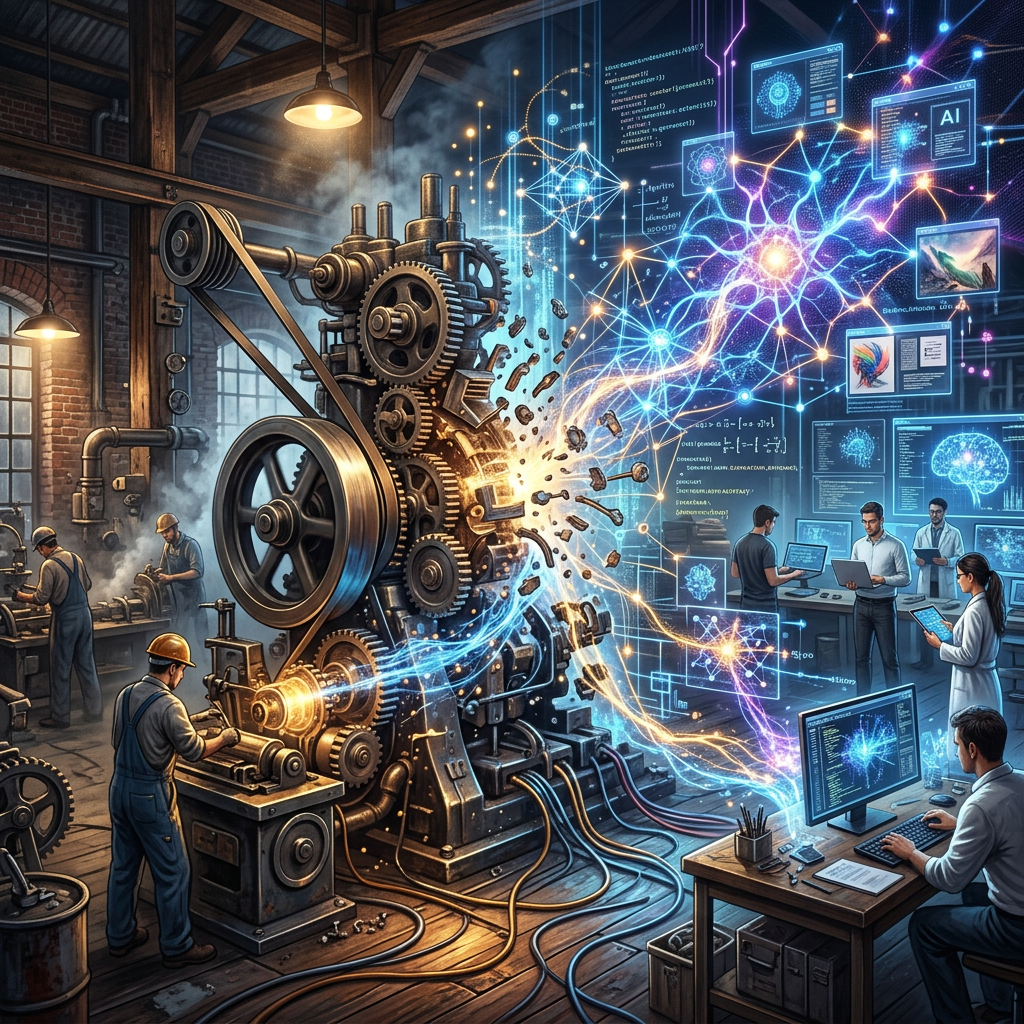
Generative AI is one of the most popular and talked about technological advancements of our times. From writing emails and creating images to helping developers code, generative AI has completely changed how we interact with computers. However, what is generative AI and how do they operate?
As opposed to traditional software which follows certain pre-set rules, generative AI is able to generate new content depending on the request of the user. This technology generates text, images, audio, video, computer code, and various other digital content. It is beneficial for students, businesses, developers, designers, marketers, and general public alike.
In this guide, we will be explaining what is generative AI and how it operates, current applications, advantages and disadvantages of this technology, as well as the future prospects of development.
What Is Generative AI?
Generative AI refers to artificial intelligence technologies that are capable of generating something new. Unlike regular AI systems that use search algorithms to look for data within a database, a generative AI algorithm creates an original response based on the patterns learned during the training.
The users may instruct the AI to create a product description, a summary of a lengthy document, an illustration of a future city, or even computer code. After receiving the request, the AI uses its algorithms to create an output based on the built-in model.
Common generative AI tools are able to work with various types of content, including:
- Texts and articles
- Images and illustrations
- Speeches and audio
- Videos
- Computer code
- Presentations
- Summaries and documents
It has become much more available, making it quite popular.
How Does Generative AI Work?
Fundamentally, generative AI learns patterns in massive volumes of data. During the training process, the AI system learns the interrelation between words, pictures, sounds, codes, or any other data input.
Once the user provides the AI system with a prompt, it utilizes its learned information in order to generate an adequate response. In case of a text generator, that would mean generating a word or a token that is expected to come next after the provided information.
Modern AI systems may include billions of parameters in order to recognize complex relationships in data.
Still, there is one important difference between how AI and humans work with information. Generative AI does not actually think like humans; therefore, the generated output may be misleading or incorrect.
Generative AI vs Traditional AI
Traditional AI programs are usually designed to do particular tasks. For instance, a recommendation program may study your history and recommend you certain products or movies.
Generative AI takes things further as it creates new content.
Conventional AI Generative AI
Predicts or classifies information Creates information
Developed for particular purposes Able to execute various creative functions
Common in recommendation applications Common in writing applications and image creation
Uses predetermined objectives Reacts to natural language prompts
There is no absolute separation between the two kinds of intelligence. Most modern applications use both conventional and generative AI.
How is Generative AI Being Used Currently?
Generative AI is not confined to just research labs. It is being applied to various sectors as well as daily tasks.
Content Creation
Writers, bloggers, and marketers employ generative AI to get inspired for their work, outline articles, and polish drafts.
For instance, a person who creates content can ask AI to come up with ten ideas for an article and then research the topic on their own. This way, they can save time on boring work and keep the main responsibility for their work with themselves.
Content generated by AI should be thoroughly checked since the system may make mistakes and provide wrong information.
Image Generation
AI Generative technology can generate visuals based on written descriptions. The user describes a certain scene, style, or idea, and the AI image generator creates a visual based on that description.
The application of this technology includes:
Graphic designs
Design concepts
Visuals for social media
Illustrations
Creative work
Professional designers can use this tool to inspire their ideas when generating a final design concept.
Software Development
Programming assistance from generative AI has also proved valuable for programmers. An AI coding assistant can assist a programmer to learn about the code, generate functions, identify possible errors, and learn programming principles.
This could help beginners learn programming more easily. An experienced programmer can use generative AI to complete repetitive coding and focus more on the design and problem-solving aspects.
Always test the generated code before deploying it to production.
Education
Learning and work are being enhanced with generative AI by both students and educators.
AI technology can be used by students for helping with explanations of concepts, making practice questions, summarizing class material, or getting an example of complex concepts.
For educators, AI technology can be used for developing lesson ideas and exercises.
What is essential here is the notion that AI needs to facilitate the process of learning rather than substitute it. Students will have to validate the information and do the work in accordance with the requirements of their educational institution.
generative, artificial, intelligence, creation, generation, analysis, automation, machine, learning, data, model, algorithm, prediction, simulation, reasoning, decision, input, output, synthesis, creativity, innovation, prompt, response, LLM, neural, network, transformer, deep learning, content, text, image, audio, video, imitation, capability, productivity, understanding, language, design, adaptability, functionality, task, ethical, bias, responsibility, transparency, fairness, accountability, consequences
Benefits of Generative AI
One of the major benefits of using generative AI is the potential to reduce time spent on tasks. Some tasks could take several hours, but with the help of AI, they may be done much faster.
Potential other benefits include:
Quick idea generation
Enhanced productivity
Repetitive task assistance
Ease of access to creative tools
Personalized learning tool
Quick development of software programs
Assistance in communication
For the small businesses and individual creators, these features would make it easier for them to access tools they otherwise could not afford.
Conclusion
Generative artificial intelligence is revolutionizing creation, work, learning, and interaction with the help of technology. The capacity to produce text, images, code, audio, and other materials is providing an enormous array of opportunities for individuals and businesses.
However, this technology also has some limitations. AI-produced data may be erroneous, and there are issues such as privacy, copyright, biases, and responsible use that must be considered by users of the technology.
The best strategy would be to treat the technology as a valuable assistant. It can significantly speed up many activities when used in combination with human creativity, research, critical analysis, and fact-checking.