Artificial intelligence (AI) and machine learning (ML) are two of the most talked about topics these days, both of which are about how people work and how technology is improving our daily lives. From smart assistants to recommendation systems, these technologies are becoming a part of our daily lives. They have made human work much easier. Many people use the terms interchangeably, but they are not the same. Machine learning is actually a branch of AI.
Understanding the difference between AI and machine learning can help you make the best decision, whether you are a business owner, a technology enthusiast, or a student at a university or any other topic. In this guide, we will teach you what AI and ML (machine learning) are, how they work, and how they are used.
Artificial Intelligence, or AI, is what it is.
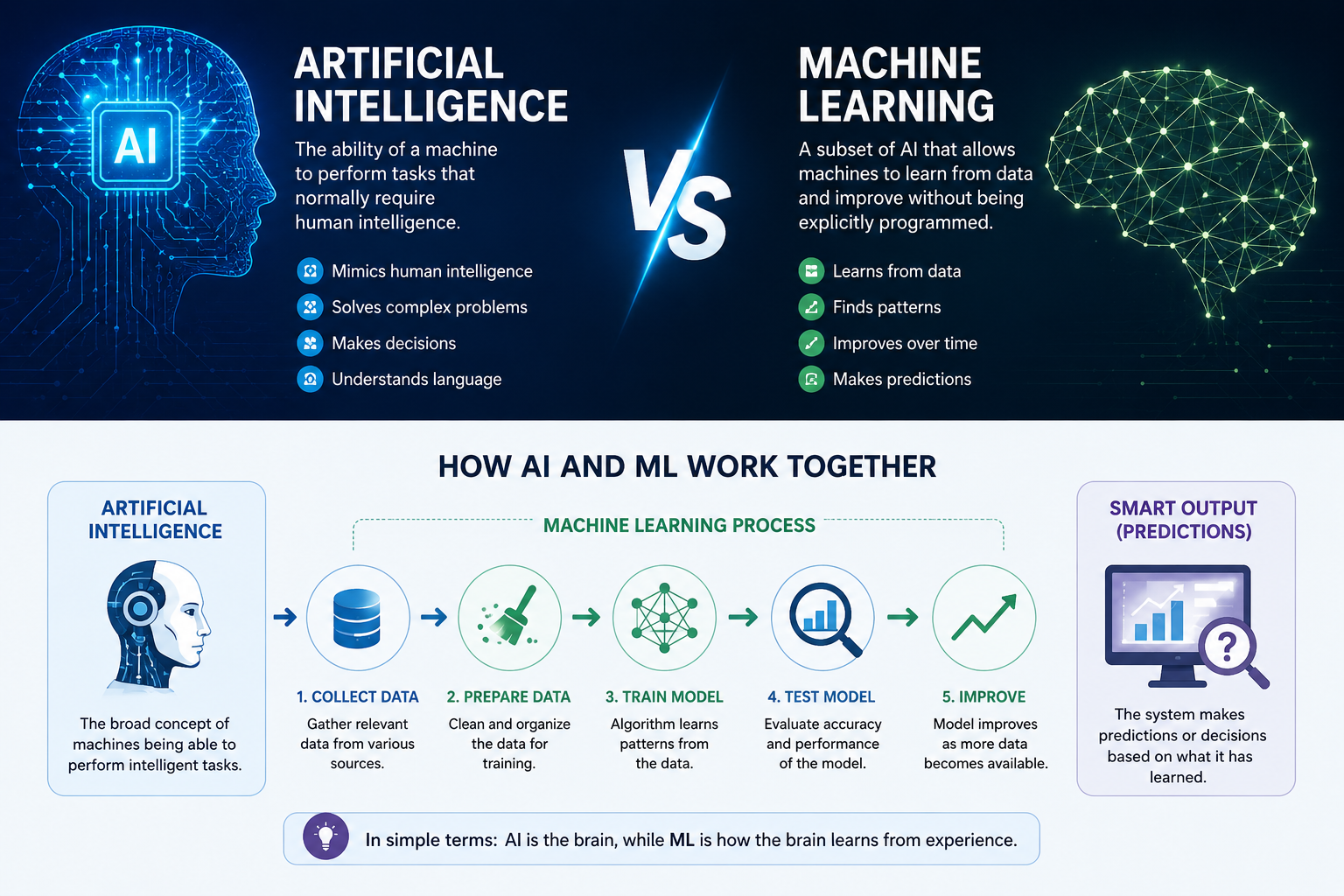
Artificial intelligence is the ability of a computer machine to perform tasks that do not normally require human intelligence. These tasks include learning, problem solving, understanding languages, recognizing images, and making decisions. The basic and most important goal of AI is to create a system that is capable of performing thinking tasks without human assistance. This is called artificial intelligence.
Some examples of artificial intelligence are as follows:
- That is, self-driving cars,
- facial recognition systems,
- smart home devices,
- self-driving bikes, motorcycles, etc.
What is machine learning?
Machine learning is a set of artificial intelligence techniques that allow computers to learn from data rather than following fixed programming rules. Instead of writing detailed instructions for every situation or every question, developers train machine learning models using huge amounts of data.
These models then look for patterns and get better at making predictions over time.
Some examples of machine learning are as follows:
- YouTube and Netflix recommendations, etc.
- Detecting email spam
- Detecting fraud in banking
- Speech recognition
- Medical diagnostic support
Difference between Artificial Intelligence and Machine Learning
| Feature | Artificial Intelligence | Machine Learning |
|---|---|---|
| Definition | A broad field that focuses on creating intelligent machines | A branch of AI that learns from data |
| Goal | Mimic human intelligence | Improve performance through learning |
| Data Requirement | May or may not require large datasets | Requires data for training |
| Learning Ability | Can include rule-based systems | Learns automatically from data |
| Scope | Very broad | More specific |
| Examples | Robots, virtual assistants, expert systems | Recommendation engines, fraud detection |
How Does Artificial Intelligence Perform its Function?
Artificial intelligence combines various technologies to solve the problems of human thinking.
These include
- Machine learning,
- Natural language processing (NLP)
- Computers
- Robotics
- Expert systems.
Together, these technologies help machines understand information make decisions, and perform intelligent actions. In this era, these technologies have great benefits and have made many tasks easier.
How Machine Learning Works
Machine Learning follows a simple process.
1. Collect Data
The system gathers relevant information from different sources.
2. Prepare the Data
The collected data is cleaned and organized.
3. Train the Model
The algorithm studies patterns within the data.
4. Test the Model
The system checks how accurate its predictions are.
5. Improve Performance
The model continues learning as more data becomes available.
Types of Machine Learning
Supervised Learning
The model learns using labeled data where the correct answers are already known.
Examples include:
- Email spam detection
- House price prediction
Unsupervised Learning
The model identifies hidden patterns without labeled data.
Examples include:
- Customer segmentation
- Data clustering
Reinforcement Learning
The model learns by receiving rewards or penalties based on its actions.
Examples include
- Autonomous vehicles
- Robotics
- Game-playing systems
Some Benefits of AI i.e. Artificial Intelligence
In this current era, AI (Artificial Intelligence) has offered many benefits, some of which are as follows:
- Automates repetitive tasks, i.e., tasks that are repeated
- Reduces human errors and helps to do a better job
- Improves productivity
- Enhances customer experiences.
Some Benefits of Machine Learning
Along with artificial intelligence, machine learning also provides significant value. Some of its benefits are listed below.
- Learns from experience
- Helps improve forecast accuracy
- Best detects hidden patterns
- Helps businesses make better decisions
What will be the future of artificial intelligence and machine learning in the future?
The future looks promising for AI and machine learning.We can expect the best of both
- Healthcare innovation
- Smart cities Robotics
- Cybersecurity
- Personal education
- Financial services
- Manufacturing automation
As technology continues to advance, AI and machine learning are transforming industrial businesses across the world.
Conclusion
In today’s technology-driven world, understanding artificial intelligence and machine learning has become very important. Although artificial intelligence focuses on creating systems that can perform tasks that require human intelligence, machine learning enables these systems to learn from data and improve over time. Both are very advanced technologies. Both technologies are changing the paradigm by increasing the efficiency of the technology, improving decision-making, and developing innovative solutions. In this current era, artificial intelligence and machine learning are helping a lot.